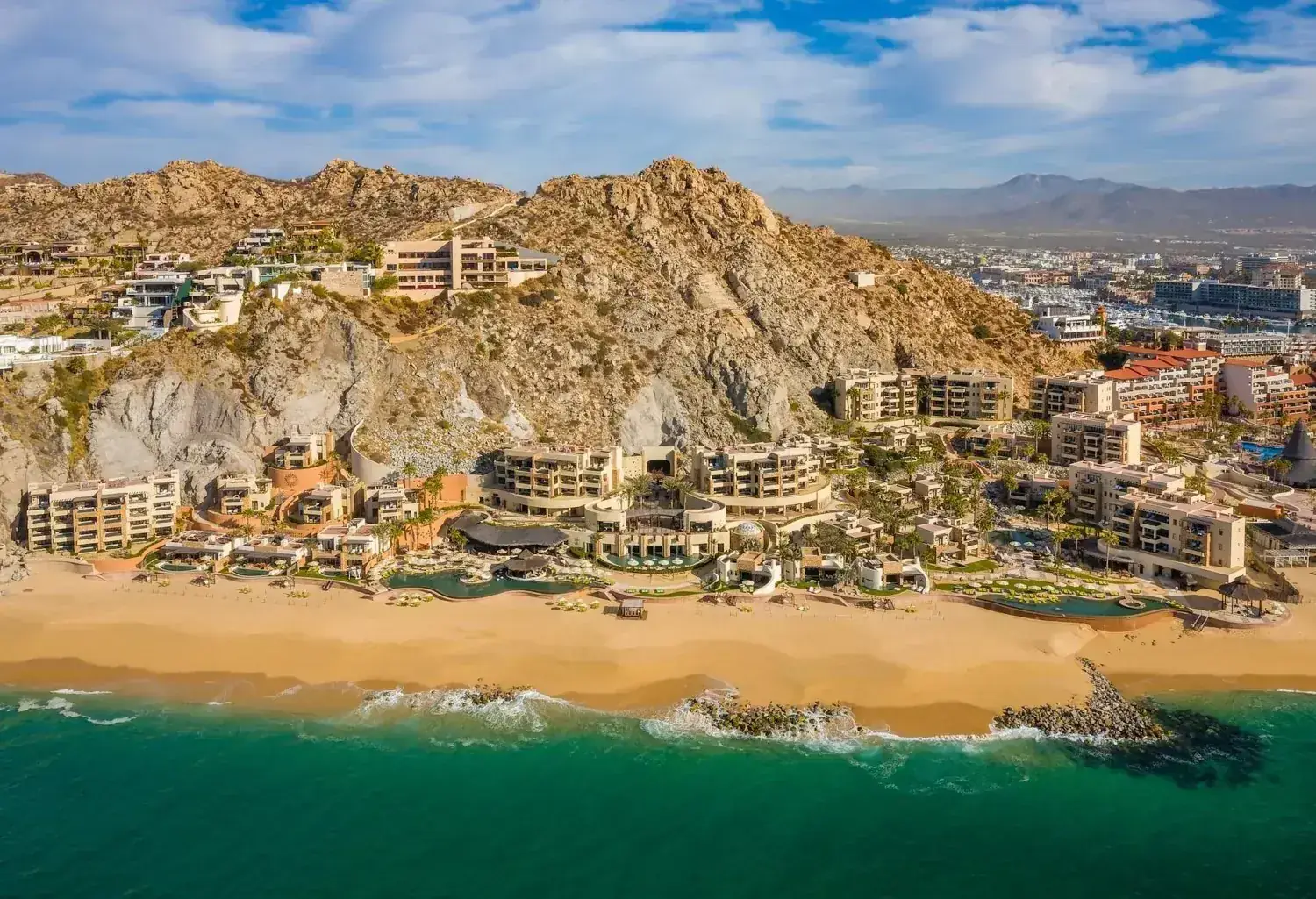
At the southern tip of Mexico's Baja California peninsula, between rock, desert and the Pacific, lies a resort that shows how strongly a hotel's architecture can be shaped by its location. Waldorf Astoria Los Cabos Pedregal does not try to outdo the spectacular landscape — it makes it the centre of its concept.
For owners and developers, that is exactly what is interesting: the resort treats its location not as a backdrop but as the actual product. Much of what defines the property therefore cannot be copied — it is inseparable from this place.
The way in becomes the staging
Perhaps the resort's most unusual idea is its approach. The guest reaches the hotel through the private Dos Mares tunnel, which runs directly through the mountain onto the roughly 24-acre site. For a moment the landscape disappears; rock and darkness dominate perception. Then the tunnel ends — and the view of the Pacific opens up before the guest.
This transition is more than an unusual driveway. It deliberately creates a moment between two worlds — Cabo San Lucas on one side, a secluded resort by the sea on the other. Before a room has been entered or a key handed over, the hotel has already made its first lasting impression: arrival itself becomes part of the hotel product.
Architecture that yields to the landscape
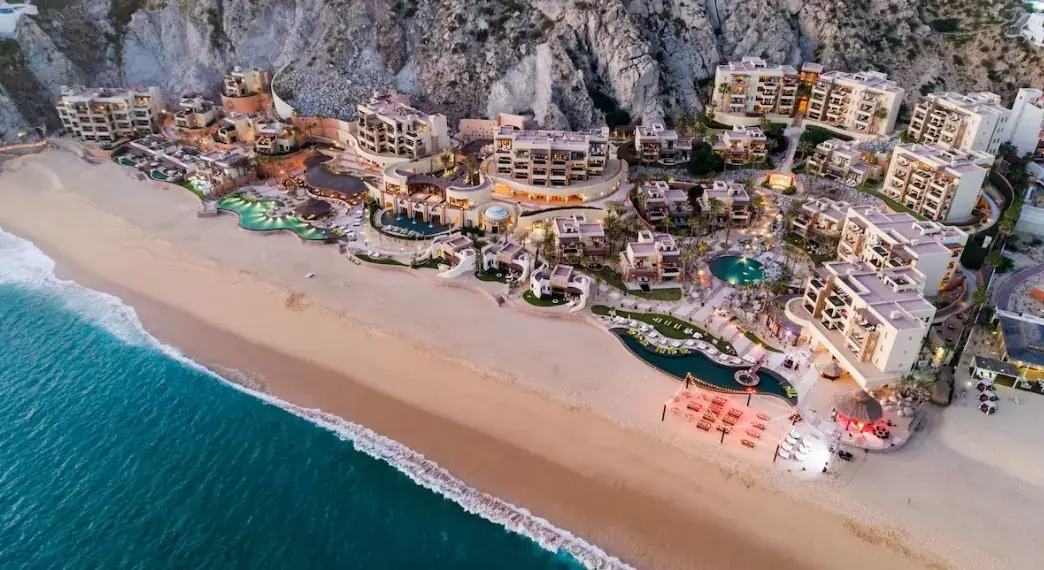
The resort was not conceived as a single monumental hotel block. Instead, lower buildings spread across the rocky terrain and follow the existing topography. Stone, warm earth tones, wood and traditional Mexican design elements tie the architecture visually to its surroundings. The result feels less like a classic large hotel and more like a cluster of private retreats on the Pacific.
This reflects a deliberate design decision. In spectacular locations there is a quick temptation to create equally spectacular architecture. Los Cabos Pedregal takes the opposite approach: the building is not meant to play the lead role — the landscape is.
112 rooms — and each gets its own experience
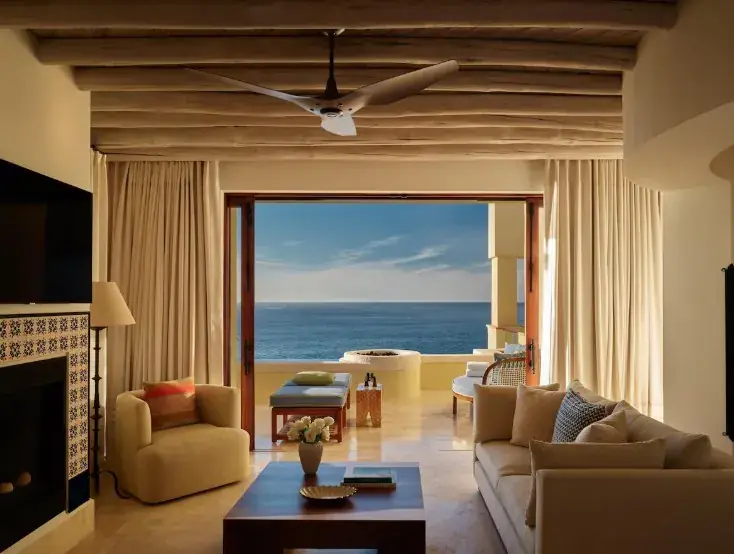
The resort has 112 rooms and suites. What is remarkable is less that figure than the way the product is built: every category — from rooms through suites and beachfront suites to casitas and villas — has a private terrace and its own plunge pool, most with panoramic Pacific views. An element that in many hotels would be reserved for a small number of premium categories thus becomes part of the base product.
The private pool is not simply an extra amenity but supports the hotel's actual positioning: privacy. The guest should be able to experience the Pacific without necessarily having to visit a public hotel area.
When fewer rooms can be more
From a real-estate perspective, the resort raises a fundamental question: does an exceptional plot always have to be developed to maximum density? In classic hotel development, the number of possible rooms plays a decisive role — more keys can mean more revenue and can spread land and development costs across more units. In the absolute luxury segment, however, a different calculation can apply.
Generous outdoor areas, distance between units, terraces, private pools and open sightlines all require space — and may thereby reduce the number of rooms that can be realised on a plot. Yet this seemingly unproductive area can itself become the product. What is sold is then not merely a night's stay, but privacy, space and exclusivity.
The landscape as the scarcest asset
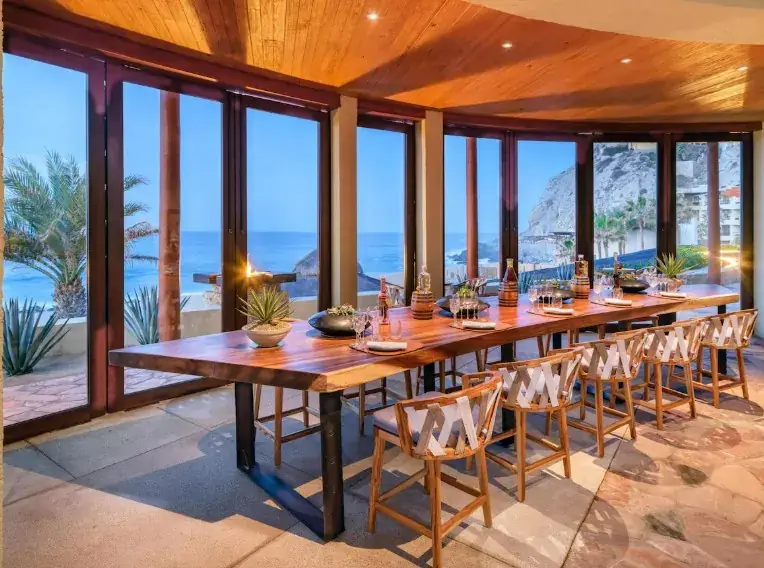
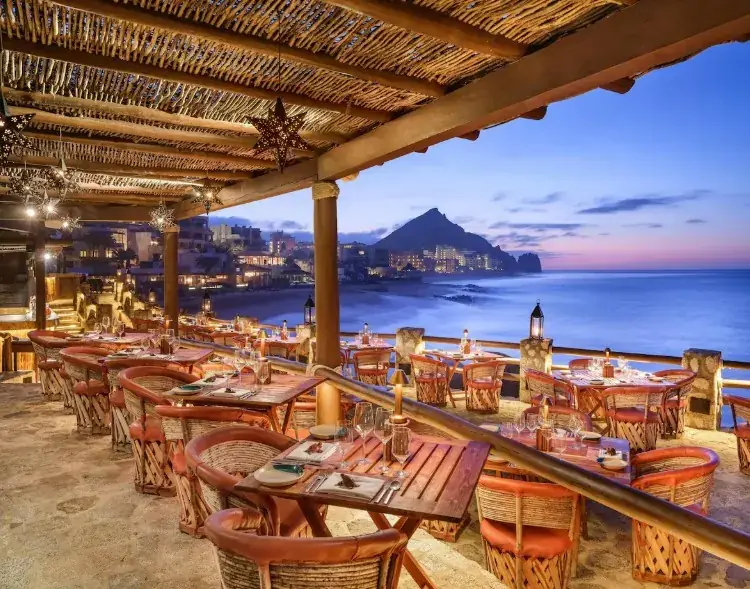
At Waldorf Astoria Los Cabos Pedregal, the Pacific is therefore not simply a pretty view but part of nearly every important decision. Rooms face the sea, terraces extend the interiors outward, pools create private retreats, and restaurants such as the cliffside El Farallón use the dramatic setting between rock and water. The result is a hotel whose concept is hard to separate from its plot.
That is precisely a special quality. A successful standard hotel concept may be repeatable in Madrid, Berlin or Dubai. A genuinely location-specific hotel, by contrast, works exactly where it is, because architecture and landscape form the product together.
Luxury also means retreat
This is especially clear in the larger categories. Beachfront suites in some cases combine private pools with their own beach access; casitas and villas expand the classic hotel room into generous indoor-outdoor living areas and, in some cases, add personal butler service. This also shifts the definition of luxury: here it means not only high-quality materials, service or size, but above all not having to share — one's own terrace, one's own pool, one's own view of the Pacific, and in certain categories even one's own access to the beach.
This form of privatising the hotel experience is a central part of the positioning — and one reason the property is sold not on the number of rooms but on the quality of retreat.
How do you modernise an icon?
An exceptional hotel concept cannot remain static. The resort recently completed the final phase of a multi-year, comprehensive transformation in which all 112 rooms as well as suites, beachfront suites, casitas and villas were redesigned. The deliberate aim was to combine modern functionality with Mexican craftsmanship and regional identity.
This raises an important question for established properties: how much change can a strong identity absorb? A renovation may modernise a hotel, but it should not remove the very thing for which guests loved it in the first place. With iconic properties in particular, preserving the existing character can be just as important as the new design.
When a plot becomes an experience
Waldorf Astoria Los Cabos Pedregal shows powerfully that exceptional hospitality need not begin with exceptional architecture. It can begin with the plot — with a rock, a sightline, the sea, or even a tunnel. Only through the right staging do these existing qualities become part of the hotel product. Perhaps that is the resort's most important idea: sometimes the best hotel architecture lies not in adding as much as possible to an exceptional location, but in making as much of it as possible experienceable.
The NOWA perspective
For owners, developers and operators, Los Cabos Pedregal offers a clear lesson: in developing a hotel, the question should not only be how many rooms can be built on a plot. An at least equally important question is what this plot possesses that no other does — and how a hotel concept can be developed from it.
At Waldorf Astoria Los Cabos Pedregal the answer is: rock, seclusion and the Pacific. The tunnel turns that into an arrival, the architecture turns it into privacy, and the hotel turns it into an experience. An exceptional location alone does not yet make an exceptional hotel — what matters is what you make of it.
Independent professional commentary. NOWA HOTEL LICENSE has no business relationship with the hotel mentioned, with Waldorf Astoria / Hilton or with The Resort at Pedregal. Information and imagery from publicly available sources; all brand and image rights remain with their respective owners.