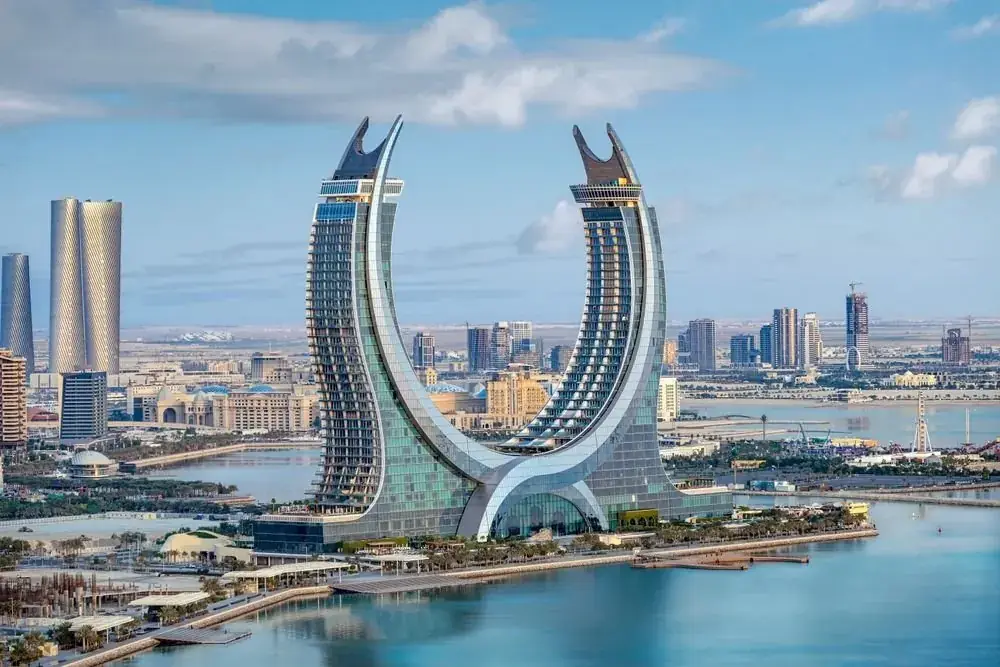
On the Lusail Marina, the Katara Towers rise with a silhouette that can hardly be confused with any other building. Two vast towers, curving outward, together form an architectural symbol whose design was inspired by the crossed swords in Qatar's state emblem. The story of this hotel thus does not begin in the lobby — it begins on the horizon.
For owners and developers, that is precisely what is interesting: a building recognised by its silhouette is an asset that a conventional marketing budget could hardly buy. Before a guest knows Raffles Doha, they may already know the building — and the property thereby becomes part of the brand itself.
When a building tells a story
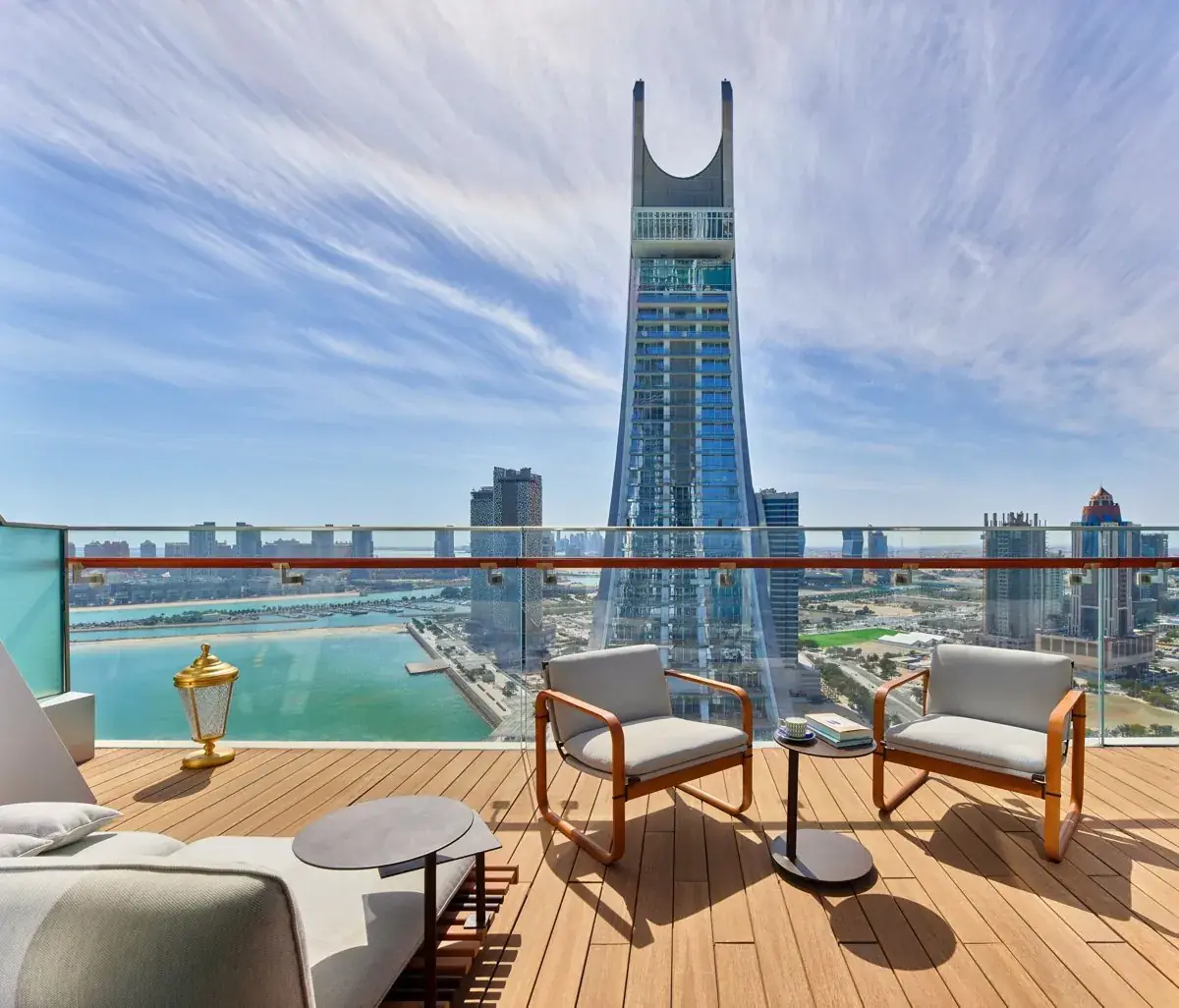
Architecture can be functional, efficient and designed to fit as many rooms as possible onto a plot — or it can create an identity. At the Katara Towers, the second path was deliberately chosen: the building's form references a national symbol of Qatar and translates it into modern high-rise architecture. The result is a property with an unusually high recognition value — a single photo of the silhouette is enough to identify the building.
For a hotel, that is an enormous advantage. Recognisability is hard to create in the luxury segment and even harder to copy; a building that becomes an image in its own right supplies it, so to speak, for free. Therein lies the commercial core of iconic architecture — provided it is tied to the product and does not remain mere scenery.
132 suites instead of as many rooms as possible
The project becomes even more interesting behind the facade. Raffles Doha has just 132 accommodations — and every one of them is a suite; the property positions itself as Qatar's first all-suite hotel, with personal butler service for guests. In one of the country's most prominent new buildings, one could also have tried to fit a far larger number of classic rooms. Instead, the product was deliberately geared toward exclusivity: fewer keys, larger units, more personalisation and more service.
In this, Raffles Doha shows an important difference between classic luxury hospitality and ultra-luxury: it is not necessarily the maximum number of sellable rooms that is central, but the maximum value of the individual experience.
When a suite becomes a product in its own right
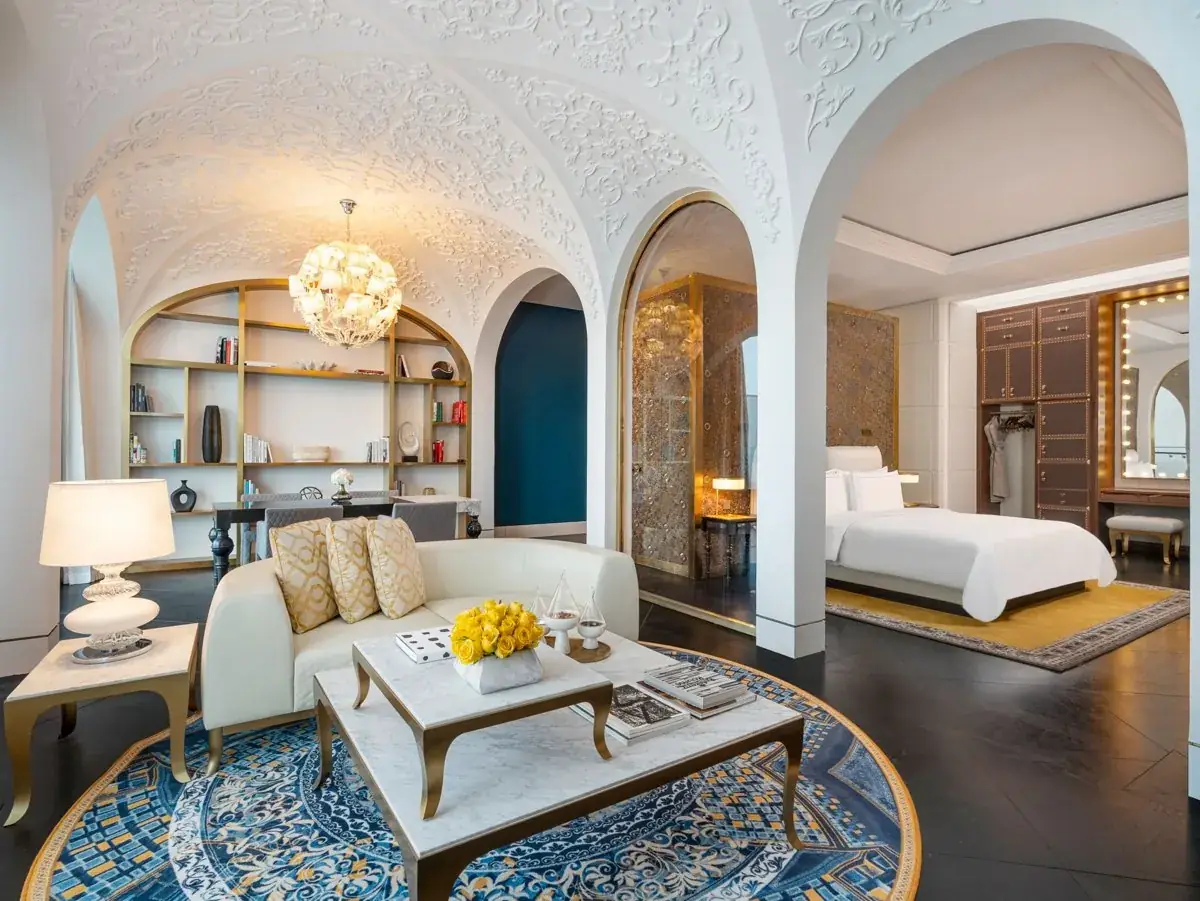
This philosophy is especially clear across the different suites. Here, the same room is not simply offered in various sizes; design, art, materials and in some cases entire themed worlds give each category its own identity. This leads to a question that grows ever more important in the ultra-luxury segment: when does a hotel room stop being merely accommodation — and become an experience in itself?
A larger bathroom or extra square metres alone are, at some point, no longer enough to explain a substantial price difference. The suite needs a story — a special view, an exceptional design, a service that stands apart, or an experience that simply does not exist in a lower category. The hotel room is thus increasingly developed like a product in its own right.
Luxury does not end at the room door
The 132 suites, however, tell only part of the economic story. Raffles Doha offers extensive dining, wellness and event facilities — the Katara Hall being especially striking. The ballroom holds up to 2,500 people in the appropriate formats and has ceilings up to 22 metres high; according to the property, it spans around 2,379 square metres and ranks as the country's largest ballroom with daylight.
This creates an interesting contrast: 132 suites — but event dimensions for thousands of guests. That is exactly why the economic assessment of exceptional luxury hotels must not end at the room count.
A hotel consists of several revenue worlds
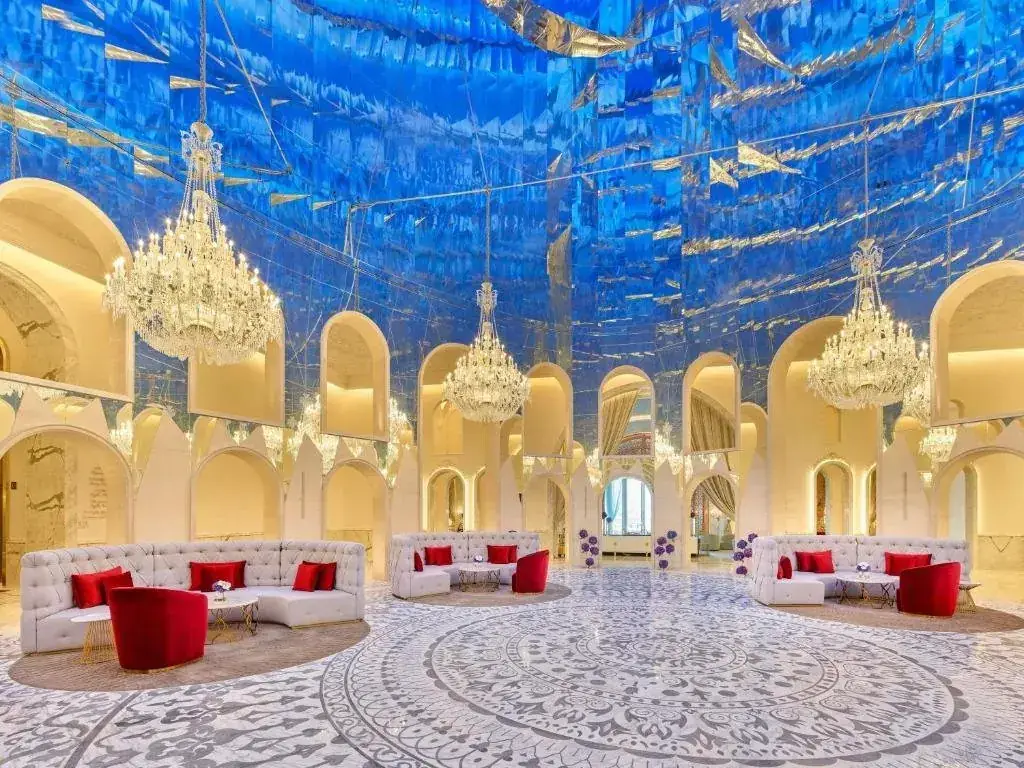
At a classic hotel, the rooms business is often central — rooms times occupancy times average daily rate. At a project like Raffles Doha, the picture is more complex: weddings, galas, conferences, restaurants, bars, spa and private events can generate their own demand, in part from guests who do not stay at the hotel at all. The building thereby becomes a platform for different hospitality products.
The 132 suites form the exclusive core, but around them a much larger commercial world takes shape. The number of rooms alone therefore says little about the economic dimension a hotel property can actually possess.
Architecture as an economic asset
The spectacular form of the Katara Towers, too, should not be viewed in purely design terms. Iconic architecture can generate attention and recognition, become part of international coverage and give a hotel a visual identity for which other brands must market for decades. Of course this comes at a price: complex facades, special structures and bespoke interiors can raise development and operating costs considerably — iconic architecture is therefore not automatically good hotel economics.
The decisive question is rather: can the architecture be tied to the product so strongly that higher costs also create higher perceived value? At Raffles Doha, exactly this connection is visible — the hotel is not simply located in the Katara Towers; the Katara Towers are part of what makes Raffles Doha what it is.
Between global brand and local identity
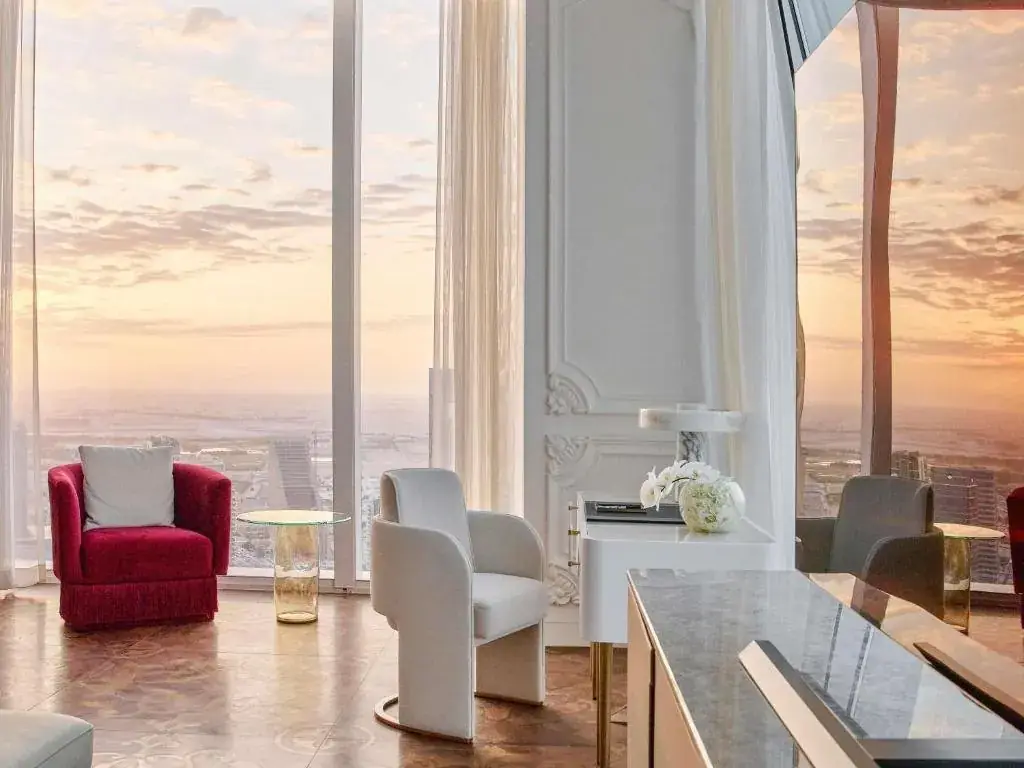
Another interesting aspect is the combination of an international luxury brand with national symbolism. Raffles stands for a global form of classic luxury hospitality; the building deliberately references Qatar; and inside, too, this connection continues: art and design draw on local craftsmanship, Arabic motifs and cultural references. Even the library is part of this narrative — the Blue Cigar lounge, for instance, gathers around 6,000 literary classics, including some first editions.
This creates a principle increasingly relevant for international hotel brands: a global standard need not mean global interchangeability. A strong brand can deliver service, quality and trust; the property and its location deliver individuality. The best concepts achieve both at once.
When the hotel becomes part of a larger real-estate concept
The Katara Towers themselves are also interesting from a real-estate perspective. Raffles is not the only hotel within the complex: the towers additionally house the Fairmont Doha with 363 keys, as well as the Katara Hall. This is therefore not merely a spectacular hotel building, but a hospitality complex in which different positionings coexist within the same landmark property.
On one side an extremely exclusive all-suite product with just 132 units, on the other a considerably larger luxury hotel, plus dining, events and one of the largest event spaces in the city. The property is thereby developed not for a single product, but into a hospitality ecosystem of its own.
The NOWA perspective
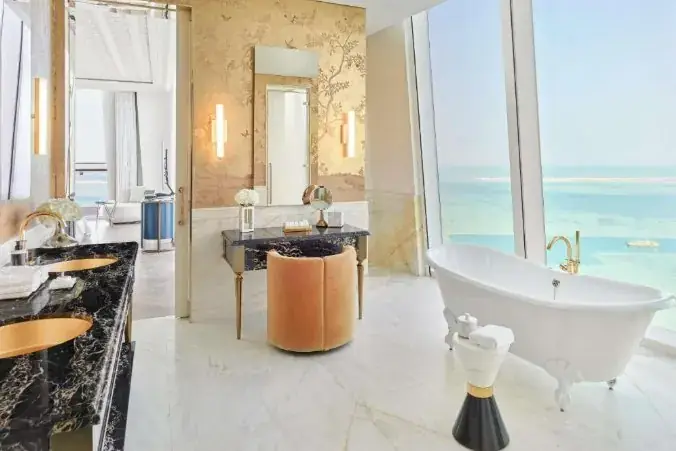
For owners, developers and operators, Raffles Doha offers an important lesson: an exceptional property can be more than the place where a hotel is run — it can become part of the business model itself. The Katara Towers create attention, the architecture creates recognition, the 132 suites create exclusivity, the Katara Hall extends the product far beyond the classic rooms business — and the international brand ties these elements into a single concept.
What is decisive here transfers to far smaller projects as well. Not every hotel needs two spectacular towers, but every hotel should be able to answer the question: what makes this property unmistakable? Sometimes it is a building's history, sometimes its location, sometimes its architecture — and sometimes its silhouette alone is enough. A strong hotel concept begins where the property is no longer merely the building, but becomes part of the brand itself.
Independent professional commentary. NOWA HOTEL LICENSE has no business relationship with the hotel mentioned, with Raffles / Fairmont / Accor or with the owners of the Katara Towers. Information and imagery from publicly available sources; individual figures (including the Katara Hall's area) as stated by the hotel. All brand and image rights remain with their respective owners.