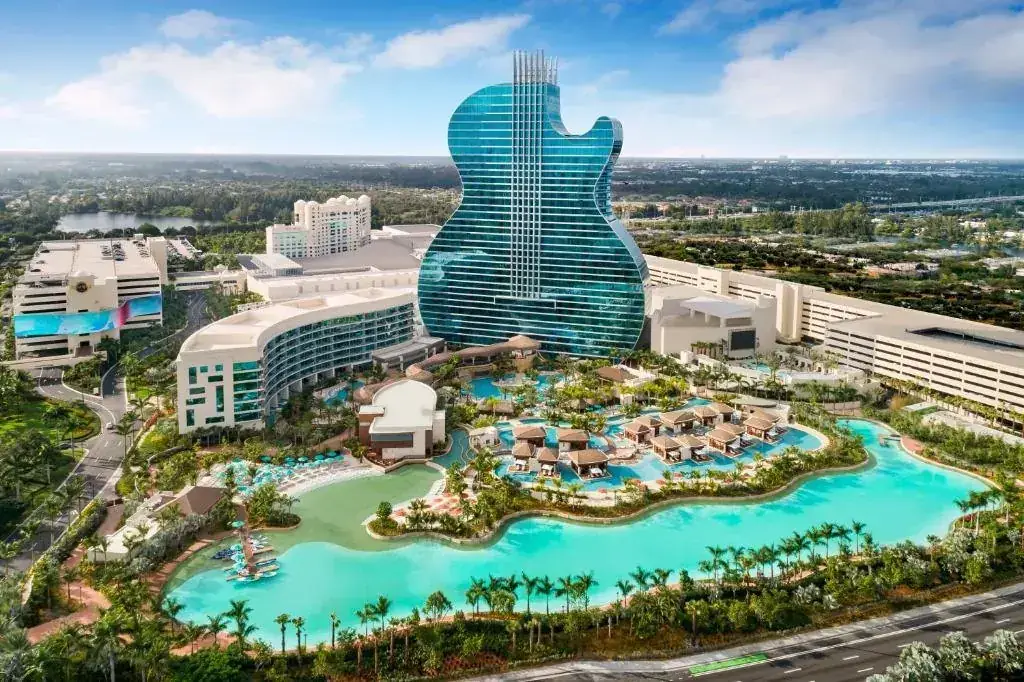
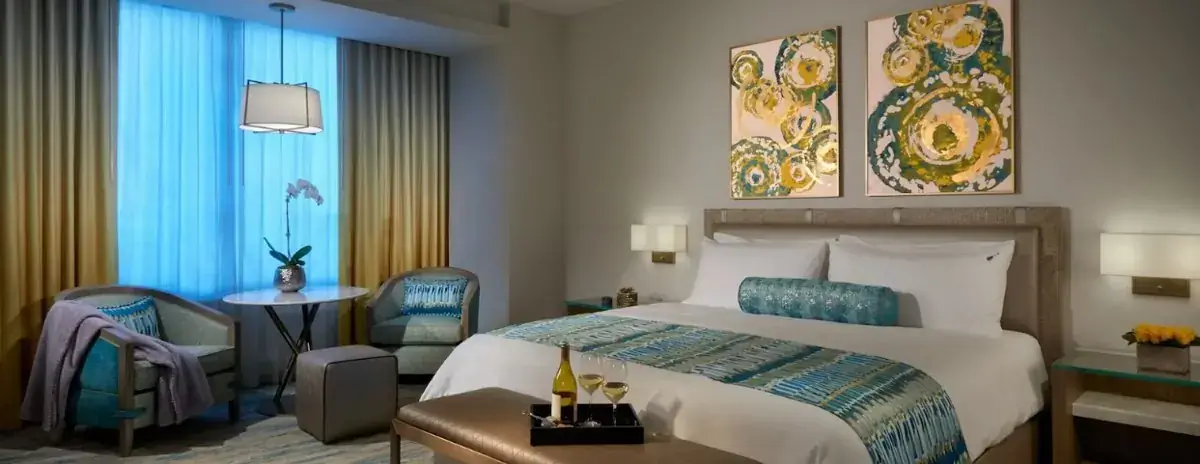
In Hollywood, Florida, a vast glass guitar rises above the South Florida landscape — 137 metres tall, with 638 rooms and suites and a facade that transforms into a giant light installation after dark. The Guitar Hotel at the Seminole Hard Rock Hotel & Casino is an extraordinary example of how far brand architecture can go.
Here, a hotel was not designed first and a brand placed on top afterwards. The brand itself became the starting point of the architecture — and that is exactly what makes the project so interesting from a real-estate perspective.
When a logo becomes architecture
Guitars have belonged to Hard Rock's visual identity for decades: they hang in the restaurants, shape the logo and form the core of one of the world's best-known collections of music memorabilia. At the Guitar Hotel, this symbol was taken radically further. The tower, designed by Klai Juba Wald Architecture + Interiors, consists of two guitar shapes set against each other and reaches around 137 metres; behind the curved glass facade lie 638 rooms and suites.
The result is a building that would need practically no signage — anyone who knows Hard Rock grasps the connection at once. This achieves something rare for hotel properties: building and brand become almost inseparable.
Can a hotel itself become a landmark attraction?
Normally a hotel benefits from its location: a property on Times Square from New York, a seaside resort from the beach, a mountain lodge from its landscape. At the Guitar Hotel, the reverse effect arises as well — the building itself becomes the attraction. Its extraordinary form generates attention, is photographed and shared; the tower is visible from far away and was deliberately developed as the landmark of the entire resort.
This changes the function of the architecture. It does not merely provide space for hotel rooms, but generates recognition, attention and demand.
A facade that becomes a stage
After sunset, the building takes on a second function. LED technology is integrated into every side of the tower; different light sequences, synchronised with music, turn the whole structure into a media facade that can be programmed nightly. Six powerful beams of light extend the imaginary guitar strings at least 20,000 feet — more than six kilometres — into the sky. A fundamentally static property thereby becomes an entertainment product: the facade is no longer merely the hotel's shell, it becomes a stage.
This is conceptually remarkable, because a hotel building is usually less visible at night than during the day. Here the opposite happens: only in darkness does the architecture unfold its full effect.
Architecture as permanent advertising
From a hotel brand's perspective, the concept has another interesting effect. Companies invest considerable sums in advertising to generate attention for their brand; at the Guitar Hotel, the property itself takes on part of that task. Every photo of the building carries the connection to Hard Rock, every video of the light show displays the brand even when no conventional logo is in focus, and every guest who shares the building spreads that message further. Architecture thereby becomes a permanent marketing instrument.
More than a hotel — and who pays for the architecture
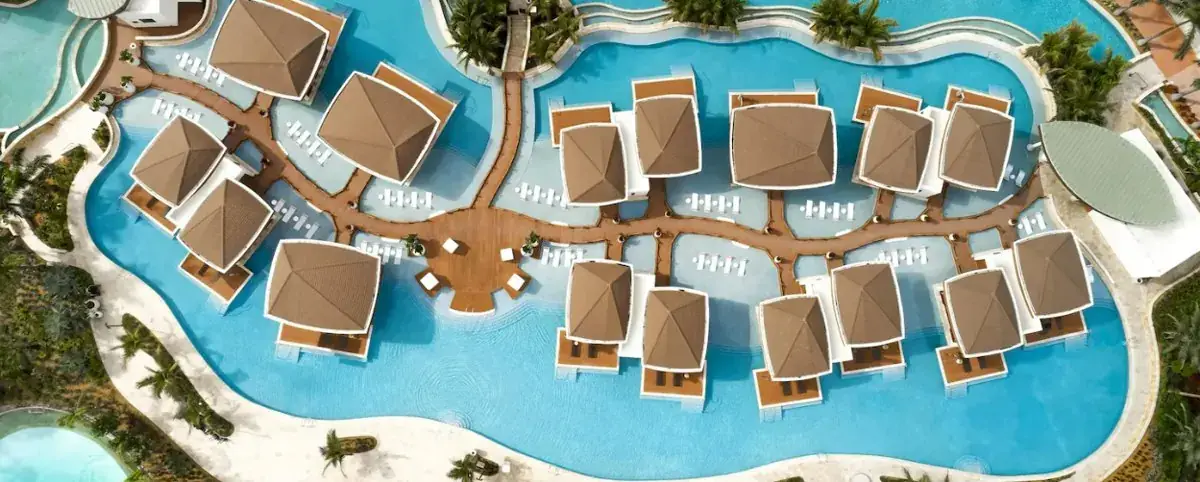
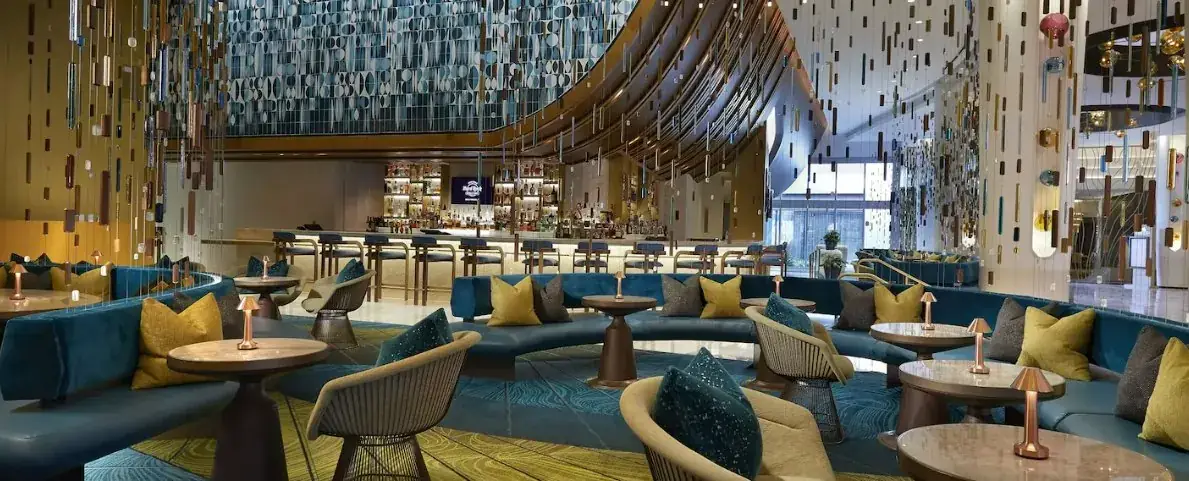
The Guitar Hotel should not be viewed in isolation. It forms the spectacular centre of the Seminole Hard Rock Hotel & Casino Hollywood — a large integrated resort. The expansion, opened in 2019, cost around 1.5 billion US dollars; in total the complex has 1,271 rooms across three towers. To this are added a 13.5-acre water and pool landscape, 19 restaurants and 20 bars and lounges, spa, retail, extensive meeting and convention space, a large casino and entertainment area, and Hard Rock Live, an arena for around 7,000 guests.
The resort therefore sells not just overnight stays but entertainment, concerts, dining, gaming, wellness and the Hard Rock brand itself — the hotel room is only one of several components of this ecosystem. And that is the honest economic core behind the architecture: a 137-metre guitar tower does not pay for itself through room rates alone. It is carried by a casino and several revenue worlds that make the spectacular form financeable in the first place. A free-standing city hotel with the same construction costs could hardly refinance such a shape through room revenue.
When architecture is meant to create demand
From a real-estate perspective, the Guitar Hotel poses an unusual question: can it make economic sense to develop a more complicated and more expensive building if precisely this architecture generates additional demand? A rectangular tower would have been structurally far simpler, and 638 rooms could have been housed conventionally — but such a building would have been just another hotel tower. The guitar shape, by contrast, creates a unique selling point that can hardly be copied.
This does not mean that spectacular architecture is automatically an economic success. Extraordinary structures can cause considerable additional development, maintenance and operating costs. The decisive question is therefore always: does the added complexity also create added value? At the Guitar Hotel that was precisely part of the strategy — the architecture was not merely meant to be beautiful, it was meant to draw people in.
The line between bold and kitsch
It is precisely for this reason that the Guitar Hotel is also architecturally interesting. A 137-metre guitar will not please everyone; to admirers of restrained architecture the building may seem excessive or even kitsch. But perhaps that is the wrong question. Hard Rock did not want to build a neutral luxury hotel — the brand stands for music, entertainment, showmanship and a certain excess. A minimalist glass box would have looked more elegant, but would have fitted the brand far less.
The Guitar Hotel thus shows an important insight: a strong hotel concept does not have to please everyone — it has to fit its target group and its brand. Recognisability can be worth more than design neutrality.
The property as content
The concept has yet another dimension that is becoming increasingly important in modern hotel development: extraordinary architecture produces images, and images produce attention. Today a guest no longer needs to be a professional photographer or journalist to make a hotel visible worldwide — smartphones, Instagram, TikTok and other platforms have turned guests themselves into distribution channels. A spectacular pool, an extraordinary lobby or indeed an entire hotel tower can thereby become content.
The Guitar Hotel was conceived years before today's social-media dynamics, yet works perfectly within that logic — the property practically invites being photographed.
The NOWA perspective
For owners, developers and operators, the Guitar Hotel offers an interesting lesson: brand and property need not be two separate things — a strong hotel property can itself express what a brand stands for. This does not, of course, mean that every hotel should take the shape of its logo. The real idea is more fundamental: if a brand stands for calm, the property should convey calm; if it stands for history, the building should tell that story; if it stands for nature, nature should become part of the architecture.
And if a brand like Hard Rock stands for music and entertainment, in the most extreme case even a 137-metre hotel tower in the shape of a guitar can result. The Guitar Hotel thus shows one of the most radical forms of hotel positioning: other hotels carry their brand on the building — here, the building is the brand.
Independent professional commentary. NOWA HOTEL LICENSE has no business relationship with the hotel mentioned, with Hard Rock International, the Seminole Tribe of Florida or Klai Juba Wald. Information and imagery from publicly available sources; all brand and image rights remain with their respective owners.