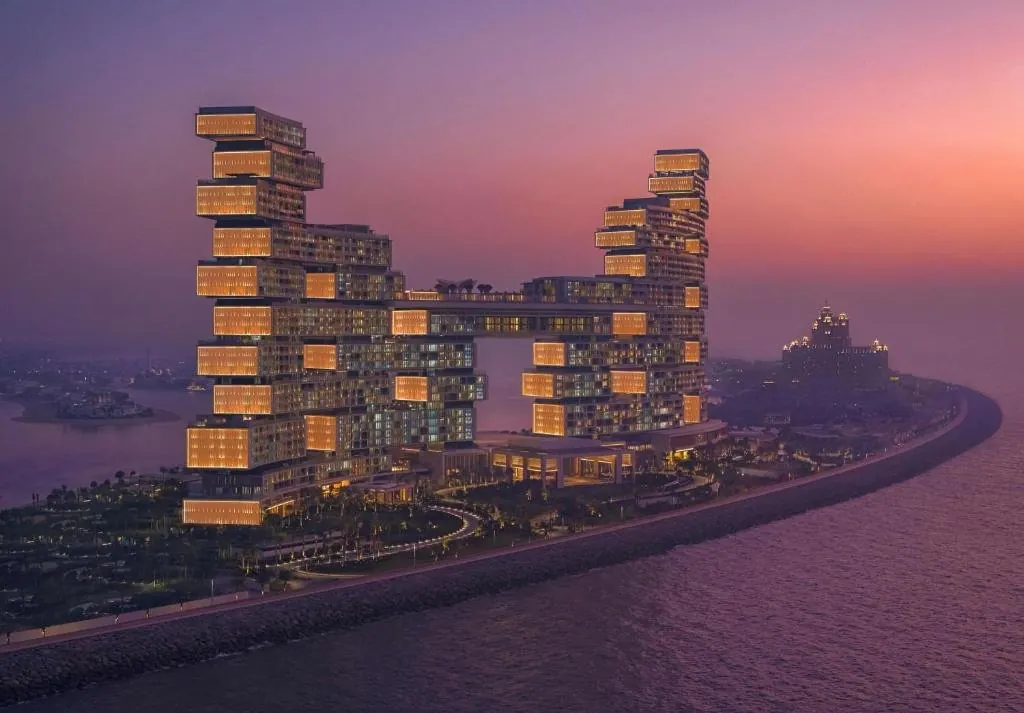
The resort, designed by Kohn Pedersen Fox, deliberately breaks with the idea of a closed hotel block. Six interconnected volumes are stacked and staggered, repeatedly opening views to the sea and skyline, linked at height by a striking skybridge. The result reads less like a single building than like a vertical landscape.
For owners and investors, what is interesting about this property is less the sheer extravagance than the question behind it: how does the product 'hotel' change when the room is no longer at the centre, but the entire experience within a single property is?
A resort that grows upward
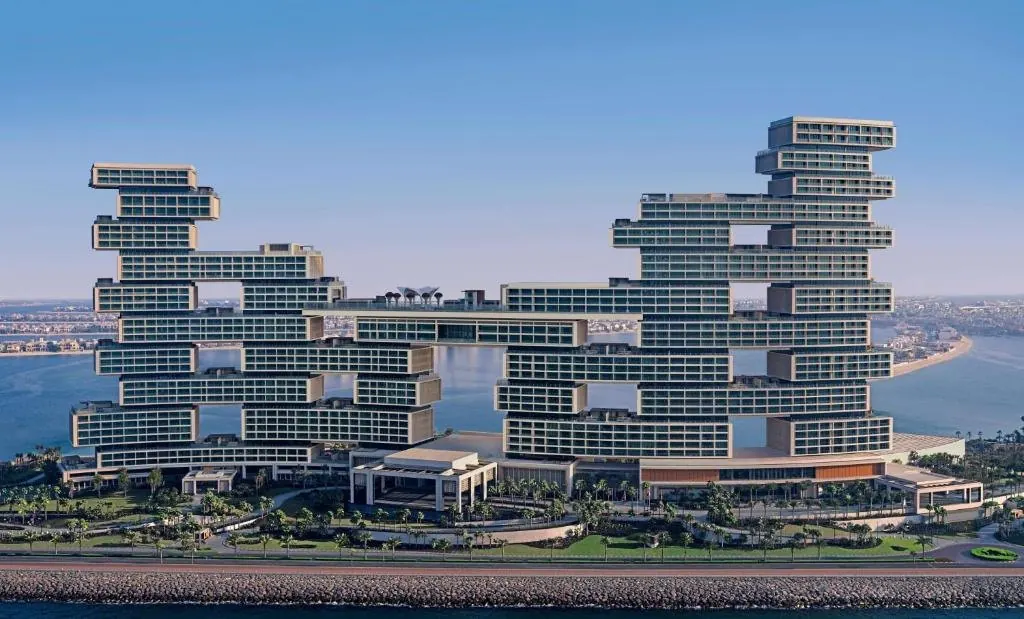
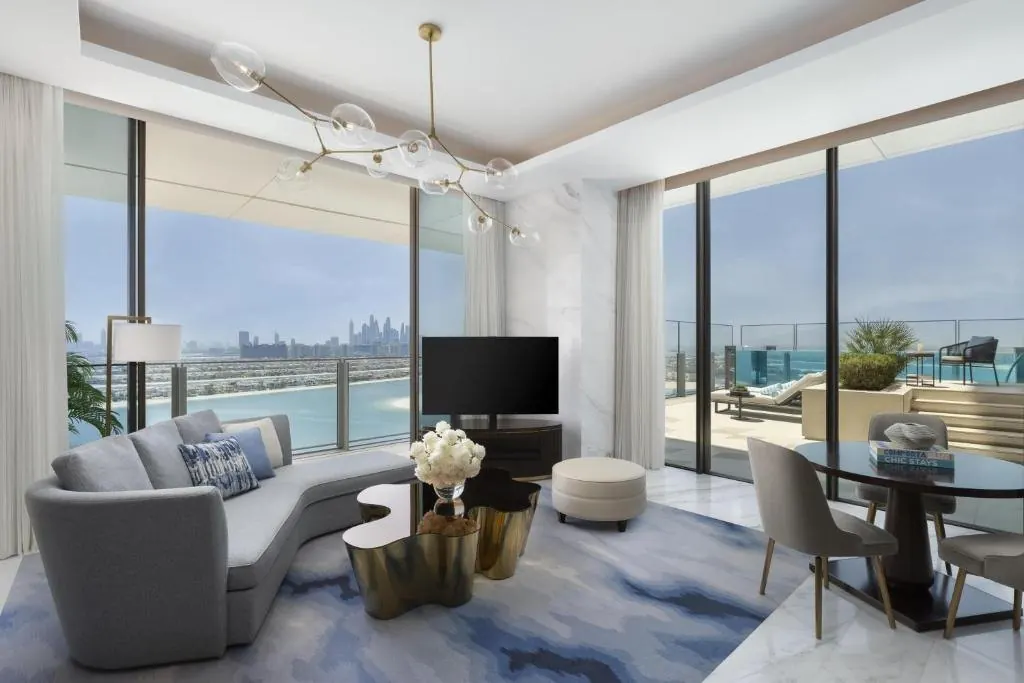
Dubai has enough classic beach resorts, so Atlantis The Royal does not try simply to be a larger one. Terraces, gardens, pools and outdoor areas run through the staggered structure, so that the connection between inside and outside is preserved even at great height. According to the property, 44 suites and signature penthouses have their own private pools.
The most spectacular rooms are therefore not simply larger hotel rooms. They take on qualities normally expected of private villas — terrace, outdoor space, privacy, a pool of one's own — and bring them vertically into a large resort. That is a remarkable development for luxury hospitality: floor area alone is no longer enough; what matters is which experiences become possible within that area.
The room is only part of the product
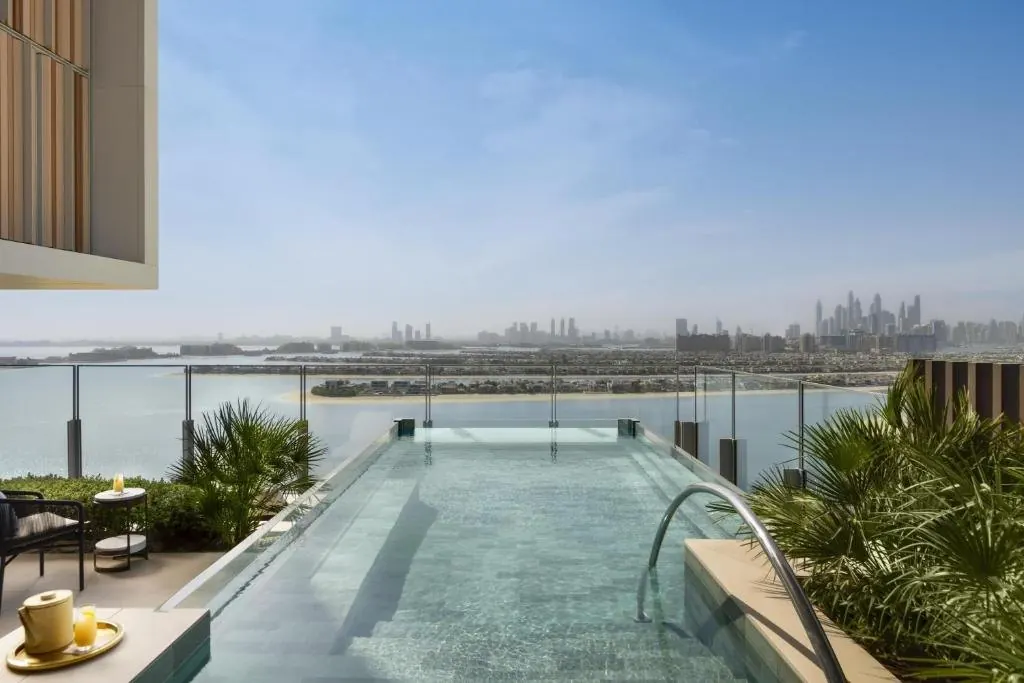
Atlantis The Royal shows how far large resorts have moved from the traditional logic of a hotel. Restaurants, beach clubs, pools, wellness, retail and public areas are not merely add-ons for overnight guests, but independent reasons to visit the building at all. With concepts such as Cloud 22, the infinity pool high above Palm Jumeirah, or a range of internationally positioned dining venues, a whole series of distinct destinations arises within the resort.
This also changes the role of the hotel room. It remains economically important, but is no longer necessarily the centre of the product — the actual product is the entire experience within the property. For economic analysis this means: to describe a large resort of this kind through rooms times occupancy times rate falls short. Value arises just as much in dining, events, beach clubs and experience spaces — partly from demand by guests who do not stay at the property at all.
Attention becomes part of the business model
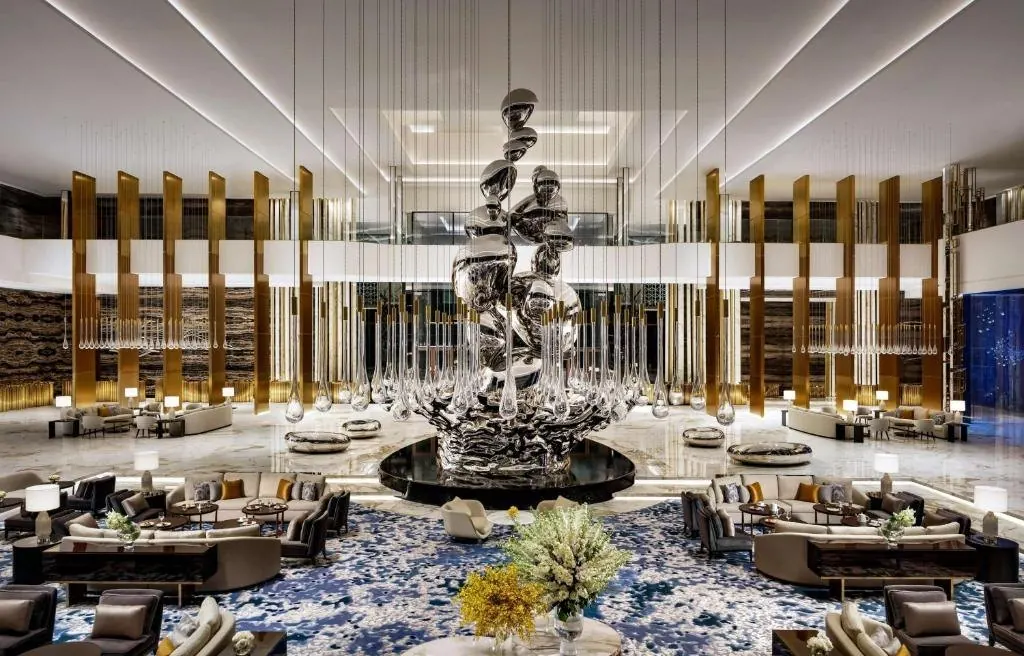
In markets with high hotel density, one of the greatest challenges is simply to remain distinguishable. Dubai is an extreme example: a new luxury hotel competes there not only on service, room size or dining, but with a host of already established top products for international attention. Atlantis The Royal answers this not with restraint: the architecture is meant to be seen, the pools to be photographed, the dining to attract external guests too. The building continuously produces images and experiences that reach beyond the actual hotel stay.
What at first looks extravagant thus follows a coherent logic: the more a property becomes a brand in itself, and the more occasions it creates to come by at all, the less interchangeable its product becomes — and the more broadly the business model rests on several legs instead of room occupancy alone.
Architecture as an economic factor
That this calculation is not merely facade is confirmed externally: in 2025 Atlantis The Royal received the inaugural Michelin Hotel Architecture Award. What is interesting is not the award itself, but that design has here become an immediate part of the brand strategy. The silhouette works on photos, on social media and in international coverage almost like a logo — the architecture thus takes on a task for which other properties must deploy considerable marketing budgets: it creates recognisability.
What transfers from this
Not every hotel needs skybridges, private infinity pools or the dimensions of Atlantis The Royal. The underlying principle, however, transfers to far smaller projects: a hotel should ideally possess at least one element that is not arbitrarily interchangeable — that can be architecture, a special location, an exceptional courtyard, a dining concept, a historic detail, a rooftop terrace or a new idea of use. What matters is not the size of the budget, but whether a guest can, after the stay, describe something they associate only with this hotel.
Atlantis The Royal takes this principle to the extreme: here a hotel was not built first and a brand developed from it afterwards — the experience within the property is the product, and the property itself is the brand. For owners and operators, though, the real lesson lies less in the size than in the question that precedes it: what about this property is unmistakable, and how does that become a viable business?
Independent professional commentary. NOWA HOTEL LICENSE has no business relationship with the hotel mentioned, with Atlantis / Kerzner or with Kohn Pedersen Fox. Information and imagery from publicly available sources; individual figures (including the number of suites with a private pool) as stated by the hotel. All brand and image rights remain with their respective owners.