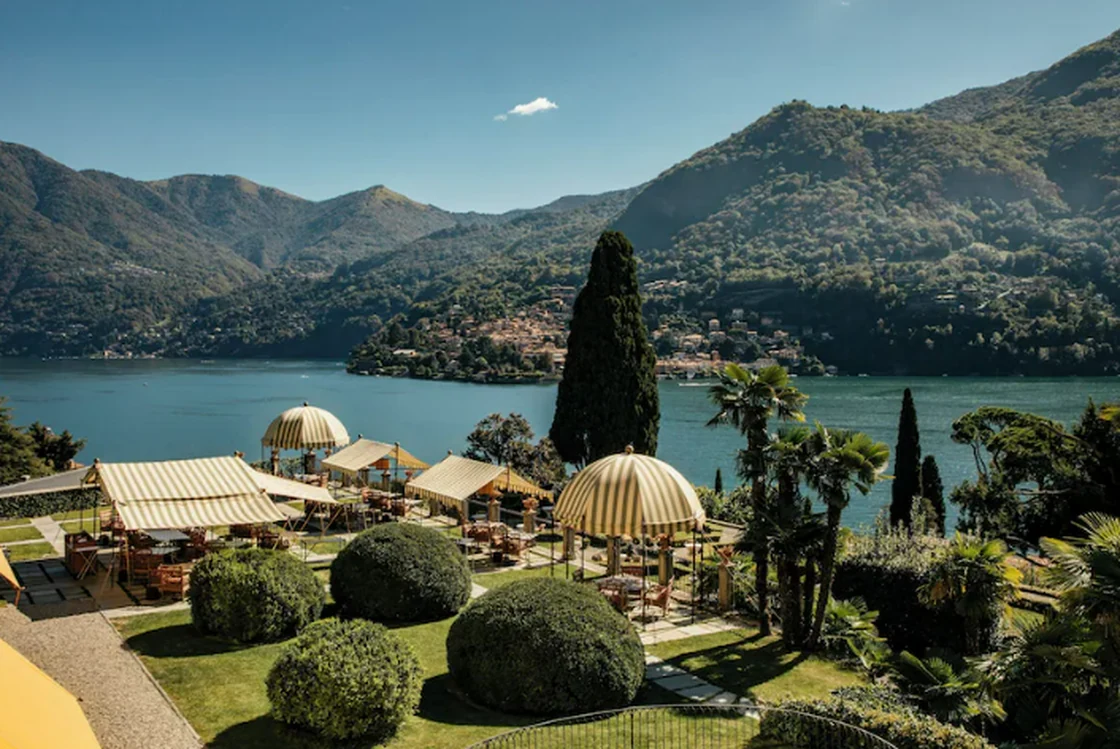
Since opening as a hotel in 2022, the historic estate became an icon of international luxury hospitality in a remarkably short time. In 2023 Passalacqua was named the best hotel in the world — number one in the inaugural “The World’s 50 Best Hotels” ranking. In 2026 it remains firmly at the top, holding fifth place and named once again the best boutique hotel in the world.
Yet its success rests on neither an international hotel chain, nor the largest possible room count, nor a spectacular brand production. Passalacqua sells something far rarer: the feeling of living, for a few days, as a resident of one of Italy’s most beautiful private villas.
From aristocratic seat to luxury hotel
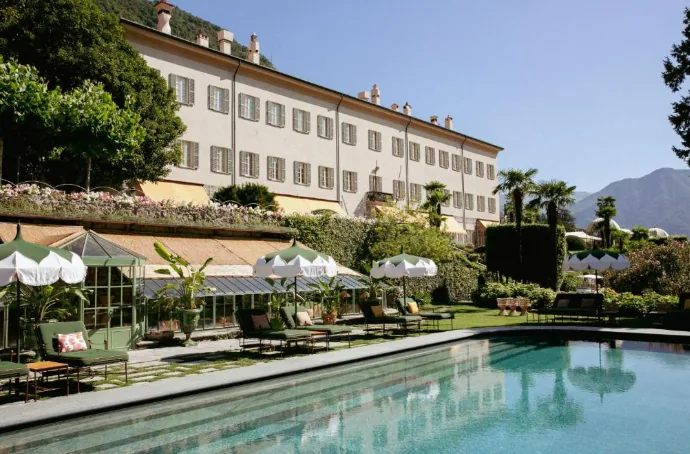
Passalacqua sits above the small town of Moltrasio on the western shore of Lake Como. The estate’s origins are tied to the family of Pope Innocent XI; the grounds once held a monastery of the Humiliati. The house took its present form towards the end of the 18th century.
The architect Felice Soave designed the villa in 1787 for Count Andrea Lucini-Passalacqua, who built here one of the grandest private country residences on Lake Como. For generations the estate received aristocrats, artists and notable figures. Between 1829 and 1833 the composer Vincenzo Bellini found calm and inspiration here. Even so, for more than two centuries Passalacqua remained, at its core, what it was originally created to be: a private house.
Only after an extensive restoration did the estate open as a hotel in 2022. The aim was not to turn the villa into a conventional lodging operation. Instead, the character of an Italian family estate was preserved. This is precisely where Passalacqua’s distinctive quality lies: the hotel feels not like a historical stage set but like a house that has grown over generations.
Three houses and only 24 rooms
The 24 rooms and suites are spread across three distinct buildings: the Villa, the Palazz and the Casa al Lago. Each has its own atmosphere, yet all three belong to one shared world.
The Villa
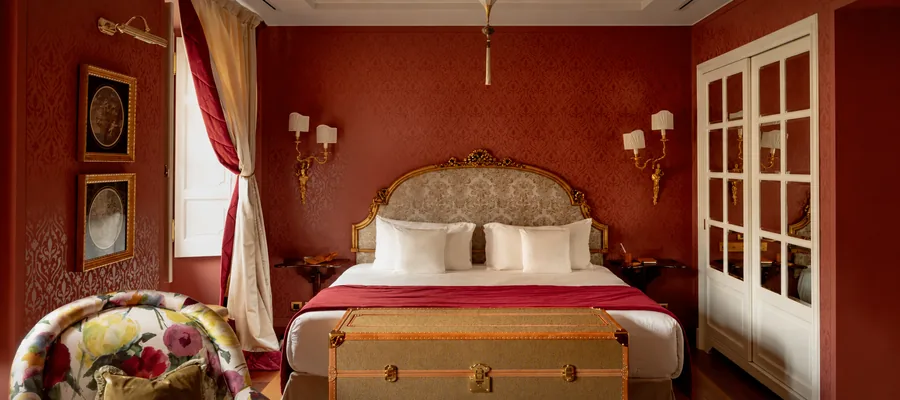
The historic Villa is the ceremonial heart of the estate. It stands raised above the gardens and opens onto a wide view of Lake Como and the mountains opposite. Its twelve rooms and suites are furnished with frescoes, antique pieces, handmade fabrics, Murano chandeliers and strong Italian colours. No room follows a standardised design scheme.
Some rooms recall private salons, others the stately bedrooms of an old family seat. Even within the same category, layouts, colours and historic details differ markedly from one another.
The Palazz
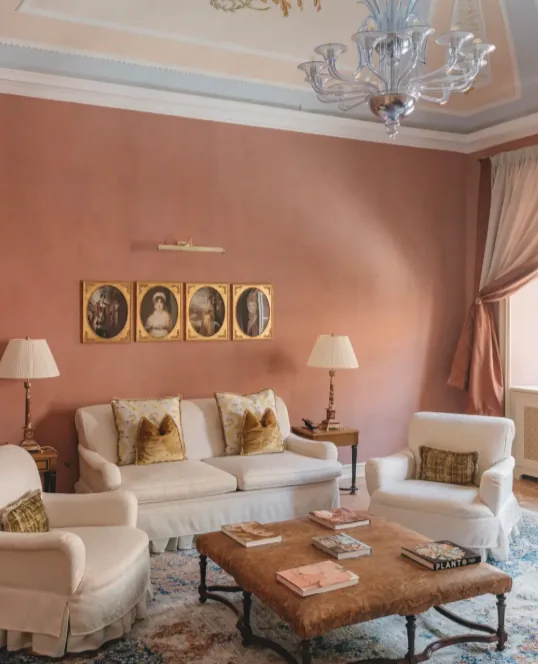
Behind the Villa lies the Palazz. This former service and stable building holds eight rooms as well as the spa. Its atmosphere is more intimate and secluded than in the main Villa. Warm tones, heavy fabrics and romantic details make the Palazz especially appealing to guests who want privacy while still using every part of the estate.
The Casa al Lago
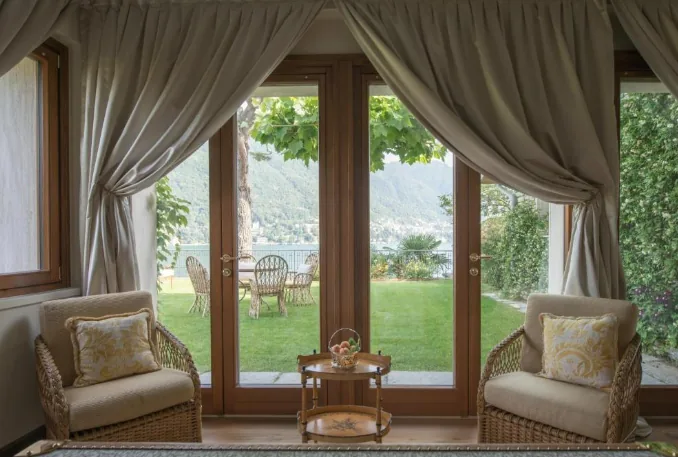
Right at the water’s edge sits the Casa al Lago. Its four rooms and junior suites offer direct proximity to the lake and, in part, access to private garden areas. The entire building can also be taken as an exclusive unit, which makes it suited to families, groups of friends or guests travelling with personal staff and security. In the Casa al Lago, Lake Como is not merely a view. It becomes an immediate part of the stay.
The Suite Bellini: 250 square metres of privacy
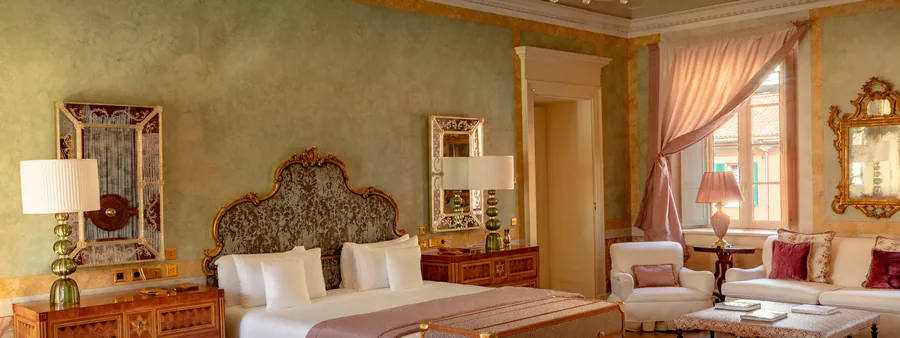
Passalacqua’s most exceptional accommodation is the roughly 250-square-metre Suite Bellini — named after the composer who once found inspiration here. Generous living spaces, historic details and the view over Lake Como suggest a private residence more than a hotel suite. Its dimensions make it possible to spend several days entirely self-contained within the suite.
Yet the true strength of the house shows not in its largest suite alone. Even the ordinary rooms were designed so individually that they stand clearly apart from standardised luxury accommodation. Passalacqua does not offer interchangeable perfection. The hotel lives on rooms with character, history and, at times, a deliberate design surprise.
A garden like a small world of its own
Around 2.8 hectares of historic gardens surround the villa. The terraces descend step by step from the main house down to the private jetty on Lake Como. Among cypresses, magnolias, roses and olive trees are fountains, small squares, hidden seating areas, a bocce court, a vegetable garden and an old pergola covered in vines.
The gardens are not merely a decorative frame for the hotel. They work like additional rooms. Guests can have breakfast, read, take an aperitif or dine in a secluded spot with a view of the lake. The pool, with its distinctive parasols, is particularly well known. Its design recalls the glamorous Italian photographs of Slim Aarons: elegant, colourful and yet completely relaxed — luxurious without feeling like a conventional luxury resort. This lightness runs through the whole estate.
Arriving across Lake Como
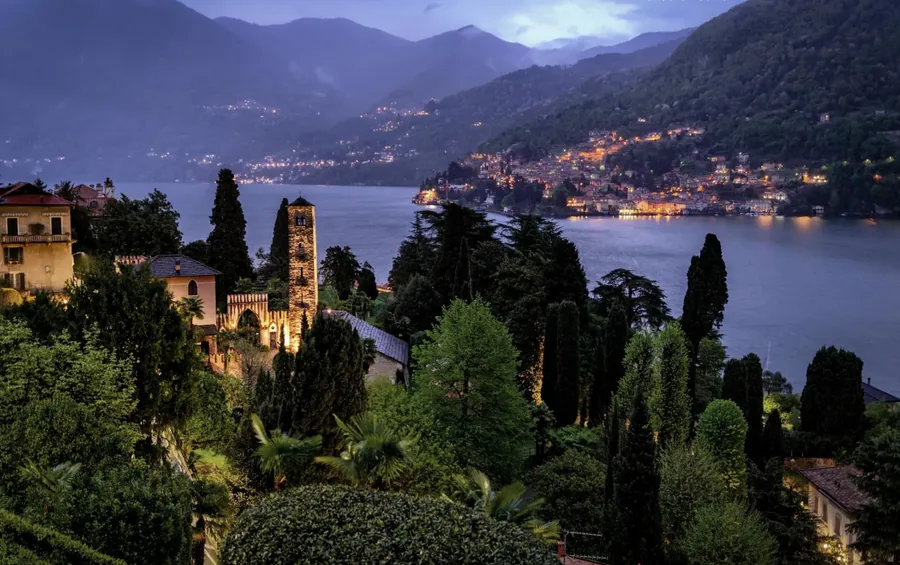
Passalacqua has its own jetty. Guests can arrive by private boat directly across Lake Como. Arriving by water is one of the most striking ways to experience the hotel. First the gardens and cypresses appear on the slope, then the villa set higher above.
At the same time, private boat access allows a discreet arrival and departure. For prominent guests, business families or those with heightened security needs, this is an essential part of the offering. The centre of Como is about 15 minutes away, and Milan is roughly an hour by car. The hotel thus combines the seclusion of a private country estate with proximity to one of Europe’s most important centres for fashion, design and international capital.
Dining as in a private Italian home
Dining at Passalacqua does not follow the classic rhythm of a hotel restaurant. Guests are meant to feel more like friends of an Italian family. The kitchen is led by the acclaimed chef Viviana Varese. The focus is on seasonal Italian dishes, regional produce and ingredients from the estate’s own garden.
You can dine on the terrace, in a historic salon, by the pool or at a spot prepared specially within the gardens. An informal conversation in the kitchen can turn spontaneously into a pasta class, a wine tasting or a bespoke menu. The guest does not have to fit the hotel’s schedule — the hotel arranges itself around the guest’s day. Service is personal but never stiff. Passalacqua does not try to make its exclusivity constantly visible; it shows in how naturally individual wishes are met.
The hidden spa beneath the garden
The spa is set in the Palazz and in a historic underground gallery laid out beneath the gardens as early as the 18th century. Today the vaulted stone rooms hold a sauna, a steam bath, relaxation areas and a heated pool. The underground area can also be reserved privately outside the regular opening hours.
Yoga beneath old magnolias, treatments in the orchard and a fitness area overlooking the olive grove complete the offering. As in every part of the hotel, wellness is not staged as an isolated product. It is part of the landscape and of life on the estate.
The secret behind Passalacqua’s success
Passalacqua has neither hundreds of rooms nor a globally known hotel brand. Even so, within a few years the house achieved an international standing that takes other hotels decades to reach. Its success rests on clear positioning:
- a historically significant property,
- only 24 individual rooms and suites,
- three clearly distinct living worlds,
- direct access to Lake Como,
- around 2.8 hectares of private gardens,
- a fully controlled guest profile,
- personal rather than standardised service,
- and a story that cannot be copied.
Passalacqua does not try to suit every guest. That is exactly what makes the hotel so desirable to its target audience. Limited availability is not a drawback but part of the product.
What hotel investors can learn from Passalacqua
From a real-estate perspective, Passalacqua is a striking example of how historic fabric can be turned into an internationally sought-after hotel product. The value of such a house is defined not only by room count, floor area or classic hotel metrics. The building’s history, its location, the gardens, access to the water and the emotional pull of the overall concept all shape what guests are willing to pay.
A small, clearly positioned hotel can, in this way, command higher prices and a stronger international profile than a far larger house without its own identity. Passalacqua also shows that luxury need not be created through a well-known chain. An independent brand can develop enormous reach when property, design, service and story are credibly bound together.
Not just: How many rooms can be fitted into a building?
But: What experience can be created that is reproducible nowhere else?
From an exceptional stay to owning a hotel
Many successful entrepreneurs first develop their passion for hotels as guests. They experience distinctive architecture, personal service and the emotional pull of an exceptional property. At some point they stop seeing a hotel purely as a destination and begin to see it as a possible investment, an entrepreneurial project or a long-term family asset.
Historic villas, boutique hotels and private resorts are among the rarest properties in the European hotel market. Many of these assets never appear on public sales platforms. Ownership changes often take place discreetly within a small international network. Passalacqua shows the potential that can emerge when an exceptional property is developed with patience, capital and a clear vision.
Conclusion: size is not a matter of room count
Passalacqua did not conquer international luxury hospitality through scale, volume or a well-known corporate brand. The hotel convinces through the opposite: few rooms, generous space, personal hospitality and a historic property whose character has been consistently preserved.
Those who stay here do not feel like a guest in a conventional luxury hotel. For a few days they live in a private Italian villa — surrounded by gardens, history and the calm waters of Lake Como. That is the real luxury of Passalacqua: not to offer as much as possible, but exactly the right thing, in a form that cannot be repeated.
Editorial analysis by NOWA HOTEL LICENSE. The hotel described is not offered by us for sale or lease; there is no business relationship with the house. Details are based on publicly available sources. Trademark and image rights belong to their respective owners and must be cleared before any publication.